Showing posts with label pollinators. Show all posts

Friday, 21 February 2014

Meadow Maker


Frome resident Sue Everett is hoping to be part of the next agrarian revolution. She is passionate about restoring wildflowers to our countryside and believes that farmers have an important role to play. Over 98% of British wildflower meadows have been lost since World War 2, largely because of changes in farming practice. Sue works with farmers, and others, to create species rich meadows all over Somerset.
Frome meadow-maker Sue Everett
The sweep of wildflowers at the Olympic Park in 2012 delighted thousands of park visitors and TV viewers of the Games. ‘The Olympic meadows were great,’ says Sue, ‘They planned carefully to create two months of high impact and it looked wonderful. It’s not the same as a meadow of native flowers that has been untouched by chemicals or the plough for many years, but it’s still very pretty!

Meadows are more than fields full of pretty flowers to Sue, though. The love of wildflowers runs deep in many of us but there are practical reasons why we need more meadows. ‘Wildflowers actually help hold the soil in place.’ explains Sue, ‘A meadow of wildflowers and grasses has a dense root system that keeps the soil from washing away in a heavy downpour. Bird’s foot trefoil, which has yellow pea like flowers, can have a root system up to 50cm deep. Rye grass, which we see planted everywhere in fields, has nothing like the same root density.’ It can take up to a five hundred years to produce an inch of top soil, so it is a precious resource that we don’t want washed away during heavy rain.

An annual meadow
Another practical reason for more meadows is to help pollinators. Meadows full of wildflowers are a feast for bees, butterflies and moths. Einstein said that if the bees disappeared, and they have been suffering a serious decline in recent years, mankind would have only have four years of life left. Without bees the flowers will not be pollinated, and without pollination there would be no fruit, tea, soybeans, cotton and many other crops. So more wildflowers is good for us all

We can see a lovely example of an historic meadow near Frome at Edford Meadows, Holcombe, where you can see 90 different flowering plants, including several types of orchid. The Somerset Wildlife Trust owns and manages the meadow. Last autumn the Frome community unsuccessfully tried to purchase Rodden Stream Lake Meadows for public use. Although they have now passed into private ownership, Sue is hopeful that the new owners will safeguard the meadow.

A mature perennial meadow with fine wild grasses
While it’s important to protect existing meadows, Sue is also enthusiastic about creating new meadows – and you don’t need to have a farm to sow a meadow.  ‘I planted a meadow in the front garden of my last home. It started out as a rockery, just a few square metres, and I ended up with nearly 40 species of flowers, grasses and sedges. I have also sown a meadow in my new Frome front garden, and on my shed roof!’
A skipper in a meadow
Meadows are a great way of bringing colour into the garden. They need less maintenance than a traditional lawn, requiring no mowing at all between April and July and less frequent mowing during the other months. It’s not an approach that suits everyone, but, if you like the idea of watching the butterflies dance across the wildflowers in your garden, sowing a meadow could be for you. They are straightforward to establish as long as you follow some simple rules. Sue advises, ‘The trick with meadows is the preparation and the aftercare. This is much the same as planting anything in a garden.’ She has identified 5 common mistakes people make when trying to establish a meado
  1. Not eradicating competitive plants prior to sowing seed
  2. Using an inappropriate seed mix
  3. Sowing at an unecessarily high rate (about 10g per square metre is enough)
  4. Not following correct management after sowing
  5. Believing that in Year 1 nothing has grown and the scheme has failed (it takes 2 years for most plants to flower), and abandoning it.
Sue can supply a suitable seed mix, as requirements do vary according to the local conditions. ‘It’s not a question of one size fits all – different plants thrive on different soils.’ she says. Wildflower seed mixes are also available in garden centres. Check the packet carefully before you buy, however. Annual flower mixes will only flower once, providing just one summer of interest. Perennials flower for many years but can take longer to get established. A true meadow has wild grasses, as well as flowers. Some packs will contain non-British seeds, which can extend the flowering period. There are many source of advice about creating meadows. Sue recommends the ‘Grassland creation and floral enhancement’ section of the Flora Locale web-site, www.floralocale.org.

A bee orchid in a mature meadow
We are lucky in Frome to have Sue the meadow-maker in our midst. Our farmers, gardeners and local wildlife can only benefit.

sueeverettmeadowmaker.blogspot.co.uk

Tuesday, 24 July 2012

Planting for Pollinators


I always thought planting for bees and butterflies was a bit of an oxymoron. Surely flowers and pollinating insects were made for each other? My suspicions were confirmed recently when I attended a fascinating Flora Locale course. I was informed that flowers and their pollinators did, unsurprisingly, evolve together. Flowers evolved to attract pollinators and the insects evolved to suit the flowers. It should not be possible to plant an insect pollinated flowering plant without attracting its natural pollinating insect.
So what happened? Well, we decided that the flowers generously provided by Mother Nature weren’t good enough for us. We wanted bigger flowers, different colours, more petals and many other changes to the original design. In the process of breeding these ‘improved’ plants we often lost original features that attract pollinators. For example, plants with a double flower do not attract pollinators as the second ring of petals reduces the space for the nectaries at which pollinators like to feed. 
Red Admiral buttefly sipping chive nectar

What’s more we went plant-hunting all over the world and imported plants that cannot be pollinated by our native pollinators. These exotic plants are often bird pollinated, for example the climber campsis (trumpet vine) is pollinated by hummingbirds. These plants can be a no-go area to our native bees and butterflies. Not always, however, it depends on similarity of the flower to our native plants. Lavender, which comes from the Mediterranean, is very popular with our native bees.
So what to plant for our native bees, bumblebees and butterflies? Recent publicity has made us all aware of how critical these insects are to our own welfare. According to the charity Buglife, one out of every three mouthfuls of food depends on pollinators. Luckily, it’s not at all complicated. British wildflowers, or their near relatives, are the best, but not only option. Flowers with similar shapes to wildflowers are just as good, as long as they don’t have double flowers.
 If you want to attract a variety of pollinators a variety of flower shapes and flowering times are important. Bees can appear as early as February so early starters like snowdrops are important. Some flower shapes, such as saucer shaped eg geraniums, daisies, scabious and umbellifers eg cow parsley, appeal to a wide range of pollinators while tubular and lipped flowers, eg foxgloves, are more specialist, appealing to bumblebees. North American perennials such as monarda and rudbeckia are good for extending the season.
  Yellow, purple and pink flowers are attractive to pollinators but they can’t see red, although they sometimes are attracted to ultra-violet markings that we can’t see. Food for all life stages is important. So caterpillars should be catered for as well as butterflies. Plant groups of the same flowering plant, not singles. Bees and butterflies like to have a good feed in one area rather than having to fly long distances to find food. This is also a good rule for planting design in general. Odd numbered groups of at least three have much more impact than single, lonely specimens.
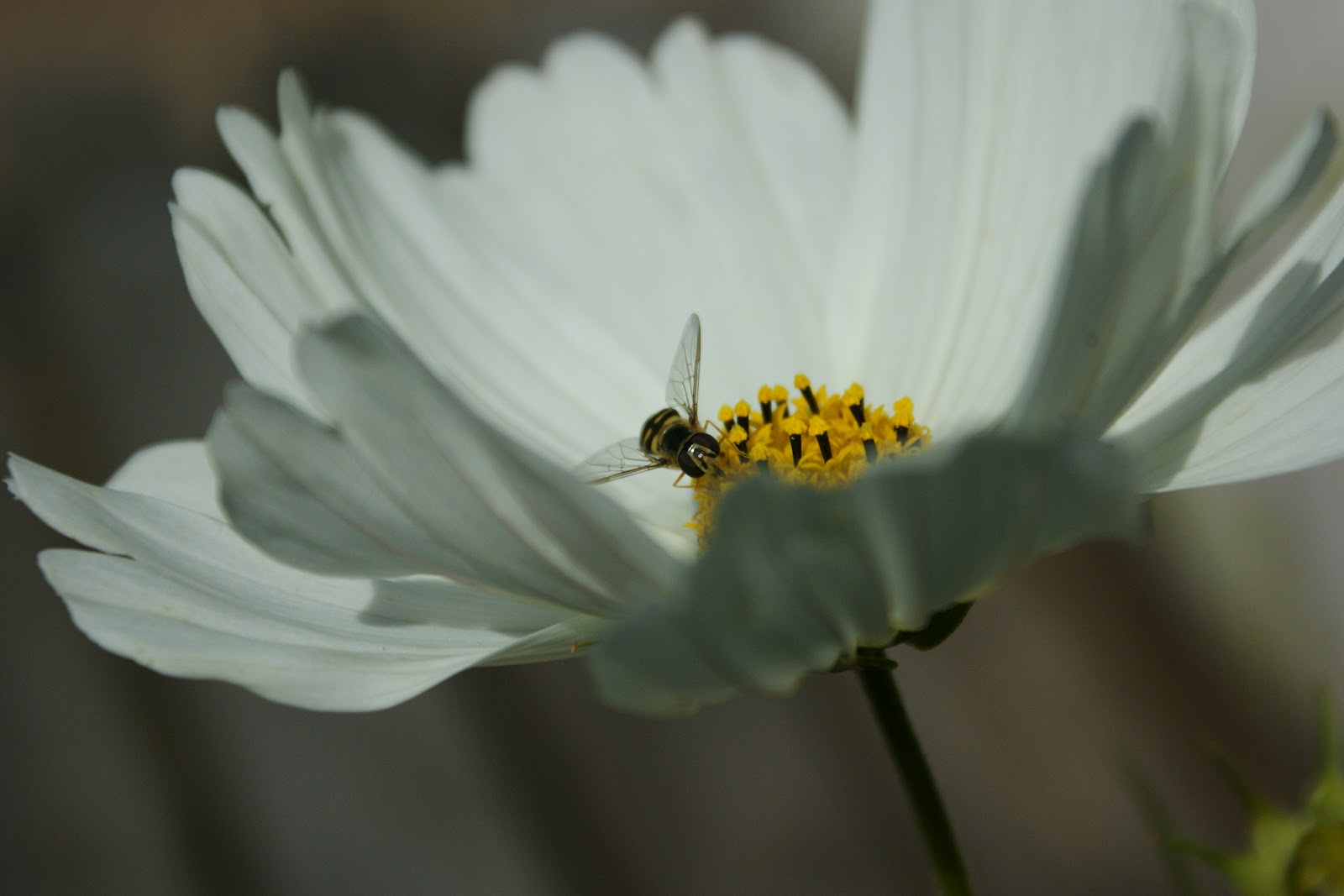
Bee enjoying a snack from the non-native Cosmos flower

Above all – don’t use pesticides! Even if you don’t kill the pollinators immediately they build up a lethal level of toxin over a period of time. The general decline of the honey-bee has been linked to pesticides which depress their immune system so they are susceptible to a mite, as well as habitat destruction.
So creating a garden full of buzzy bees and pretty butterflies is relatively straightforward and very rewarding. After all – it’s gardening as nature intended!